5 Steps to Become an AI Entrepreneur in 2026: A Complete Beginner’s Guide
If you’re starting from zero, becoming an AI entrepreneur is more accessible than ever in 2026. This guide walks you through the exact steps—from choosing your first AI tools to launching your first revenue-generating project. No coding required, no massive investment needed. Just clarity, the right AI tools, and a simple action plan. Let’s turn your AI entrepreneur dreams into reality.
- Quick Overview
- Core Breakdown: Your AI Entrepreneur Foundation
- Detailed Analysis: The 5-Step Framework
- Best Choice: Which Path Fits You?
- How to Start This Week
- FAQ: Common Questions from Beginners
- Final Verdict & Your Next Move
Quick Overview
Here’s the reality: you don’t need a tech background to become an AI entrepreneur. In 2026, AI tools have become so user-friendly that someone with zero experience can launch a legitimate business within 30 days. Let me break down what you’re actually building:
| AI Entrepreneur Path | Time to First Revenue | Startup Cost | Difficulty Level |
| AI Content Services | 14-21 days | $50-150 | Beginner |
| AI Automation Agency | 30-45 days | $200-500 | Beginner-Intermediate |
| AI Tool SaaS | 60-90 days | $500-1500 | Intermediate |
| AI Consulting | 21-30 days | $0-100 | Beginner |
Honestly, here’s my take: most beginners should start with either content services or consulting. Why? Because they require the least upfront investment and you can validate your business idea fastest. That’s how I’d do it if I was starting over today.
Core Breakdown: Your AI Entrepreneur Foundation
Before you jump into any business model, you need three core things: the right mindset, the essential AI tools, and a clear value proposition. Let me break this down simply.
The Mindset Shift: You’re not building a traditional business. You’re leveraging AI to solve real problems for people who are willing to pay. Your job isn’t to be an expert coder or designer—it’s to be a problem-solver who knows how to use AI tools effectively. That’s genuinely your only real requirement.
Essential AI Tools for Every Path: ChatGPT (or Claude) for content and ideation, Zapier or Make for workflow automation, and Canva or Adobe Express for visual content. These three handle about 80% of what most AI entrepreneurs actually need. Add Loom for video explanations and you’re covered. Most of these have free tiers—you don’t need to spend money upfront to test.
Your Value Proposition: You’re not competing on price. You’re competing on speed, quality, and reliability. “I’ll deliver your content 3x faster using AI” or “I’ll automate your team’s repetitive tasks” or “I’ll create a custom AI solution for your specific problem.” Pick one lane. Own it.
You might also like
Detailed Analysis: The 5-Step Framework
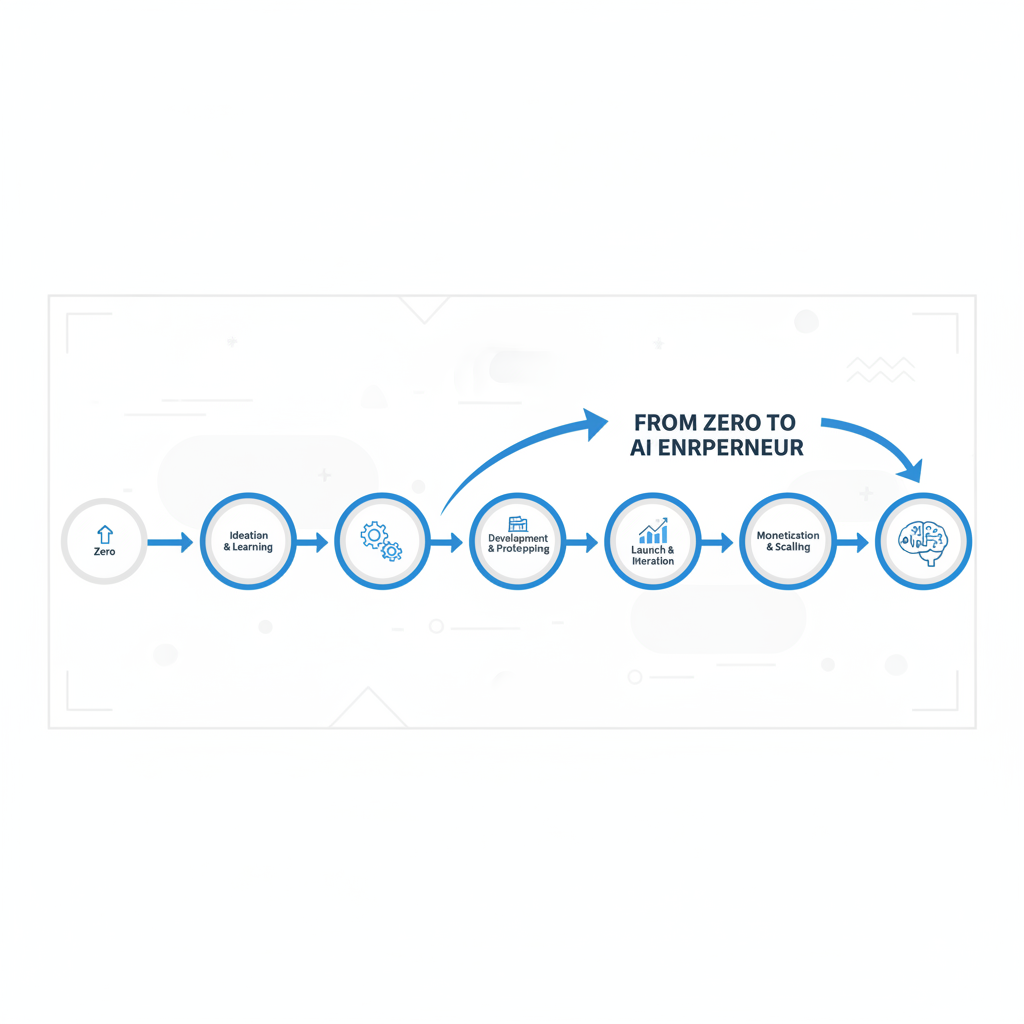
Step 1: Pick Your First AI Business Model (Days 1-3)
You have four realistic options. AI content services means you’re writing blog posts, social media content, or sales copy using AI tools—then selling it to small businesses or agencies. Startup time is fast. AI automation agencies mean you’re finding businesses with repetitive tasks, building automations using tools like Zapier or Make, and charging monthly recurring fees. This scales beautifully. AI consulting means you’re advising businesses on how to use AI effectively—high rates, low overhead. Or content creation where you produce YouTube videos, TikToks, or blogs using AI tools and monetize through ads or sponsorships.
My honest recommendation for beginners? Start with content services or consulting. Why? Less competition in consulting, faster to first client in content services. Pick based on whether you prefer one-off projects (content) or recurring relationships (consulting).
Step 2: Set Up Your AI Toolkit (Days 4-7)
Create accounts for: ChatGPT Plus ($20/month or use free version), Zapier free tier (10 tasks free per month), Canva Pro ($120/year), and optionally Loom ($120/year for unlimited video). Total investment if you go all-in? About $300 for the year. But you can start with just ChatGPT free version and Canva free. Test before buying.
Spend 3-4 hours learning each tool’s basics. Watch YouTube tutorials specific to your business model. Join communities on Discord or Reddit where people discuss these tools daily. The learning curve is shockingly shallow—most features you’ll actually use are obvious within an hour.
Step 3: Build Your Portfolio (Days 8-21)
This is non-negotiable. Even if you’re doing consulting, you need proof that you know what you’re talking about. Create 3-5 sample projects. If it’s content, write 5 blog posts or 10 social media content calendars. If it’s automation, document 3 automations you’ve built. If it’s consulting, write case studies or detailed guides on AI implementation.
Your portfolio doesn’t need to be real client work—it can be fake examples for fake businesses. What matters is that it demonstrates your capability. People want to see results, speed, and quality. Your portfolio proves all three.
Step 4: Find Your First Client (Days 15-30)
Here’s where most beginners freeze up. But it’s actually simple. You have five channels: Upwork (post a service, wait for clients), Facebook groups (join small business groups, offer services in comments), LinkedIn (connect with business owners, send personalized pitches), your network (email 20 people you know), or cold outreach (find businesses via Google and email them directly).
Your first client probably won’t come from your ideal channel. They’ll come from wherever you’re willing to put effort. Personally, I’d start with your network and LinkedIn. Less competition, higher conversion rates, people already know you’re semi-legitimate.
Step 5: Deliver Results & Scale (Days 30+)
This is where it gets real. You’ve got a client. Deliver something exceptional. Not perfect—exceptional. Better than they expected. Ask for a testimonial and a referral. That one client will often lead to 2-3 more through word of mouth. That’s how you scale without spending money on ads.
Once you have 3-5 paying clients, you’ve validated the business. Now you can decide: scale by hiring, raise your rates, or launch a second revenue stream. You have options.
You might also like
Best Choice: Which Path Fits You?
Choose AI Content Services If: You enjoy writing or creating content, you want fast client acquisition, you prefer project-based work over recurring relationships. Pricing: $500-2000 per project. Time to first client: 2-3 weeks.
Choose AI Automation Agency If: You like solving puzzles, you want recurring monthly revenue, you’re willing to spend time learning Zapier and similar tools. Pricing: $500-3000/month per client. Time to first client: 3-4 weeks.
Choose AI Consulting If: You have existing credibility in your field, you want the highest rates fastest, you prefer strategic advice over hands-on work. Pricing: $150-500/hour. Time to first client: 1-2 weeks.
Choose Content Creation If: You want to own your audience, you’re willing to play the long game (6-12 months), you enjoy being on camera or public. Pricing: Ad revenue + sponsorships. Time to first revenue: 3-6 months.
If I was a complete beginner in 2026? I’d pick content services. Why? Fastest validation, lowest barrier to entry, clear pricing, immediate client feedback. That’s how I’d test the waters.
How to Start This Week
Monday: Decision & Setup (2 hours)
Pick one business model from above. Not all of them—one. Create accounts for ChatGPT and Canva. Spend 30 minutes exploring each. Write down your service offering in one sentence. Example: “I write SEO blog posts using AI tools for $1000 per 10 posts.”
Tuesday-Wednesday: Portfolio Building (6 hours)
Create 3 sample projects. Use AI heavily but make sure the output is genuinely good. Test it on actual humans—friends, family, your network. Ask: “Would you pay for this?” Their honest answer matters more than your opinion.
Thursday: Website or Landing Page (1 hour)
You don’t need a complex website. Use Carrd (5-minute setup), one-page portfolio, or just link to a Google Drive with samples. The goal is to look legit. That’s it. Don’t get stuck here building the “perfect” site—it doesn’t exist.
Friday: Outreach (2 hours)
Send 20 personalized messages to potential clients. LinkedIn, email, Facebook messages—wherever they hang out. Keep it simple: “Hey [name], I noticed [specific observation about their business]. I help [your service]. Would you be open to a 15-minute chat?” Include a link to your portfolio. That’s genuinely all you need.
Saturday-Sunday: Feedback Loop (1 hour)
Review your samples. Did anyone respond? What questions did they ask? Adjust your offering based on actual feedback, not assumptions. This is your competitive advantage—listening and iterating fast.
That’s one week. By Sunday, you’ve tested the market. You have actual feedback. You can now decide: double down or pivot. That’s exponentially better than most people who spend six months planning before taking action.
You might also like
FAQ: Common Questions from Beginners
Q: Do I need to learn coding to become an AI entrepreneur?
A: No. Most AI tools in 2026 are no-code. ChatGPT, Zapier, Make, Canva—all require zero coding knowledge. If you can use Google Docs and email, you can use these tools. Coding is optional, not required.
Q: How much money do I actually need to start?
A: You can start with zero. ChatGPT free version exists. Zapier free tier covers 10 automations per month. Canva free is robust. Your only real cost is time. If you want to go all-in on paid tools, maybe $300/year. But you can validate the entire business model for free first.
Q: What if I fail? What’s the downside?
A: You lose maybe 30 days of effort and $300 in tools. That’s it. Compare that to starting a physical business—you could lose thousands. AI businesses are genuinely low-risk. The downside is manageable.
Q: Can I do this part-time while keeping my job?
A: Absolutely. Most successful AI entrepreneurs I know started while employed. Spend 5-10 hours per week building. Once you have 2-3 clients, you can decide if full-time makes sense. No pressure to jump immediately.
Q: How do I price my services as a beginner?
A: Start low. $500 per project or $50/hour for consulting. You’re buying credibility, not maximizing revenue. After 5 clients, you’ll have testimonials and case studies. Then raise rates to $1500+ per project or $100+/hour. Price increases as you gain proof.
Final Verdict & Your Next Move
Here’s what I want you to remember: becoming an AI entrepreneur in 2026 isn’t about being smarter than everyone else or having perfect skills. It’s about taking action when most people are still planning. It’s about learning while doing, not learning before starting.
The framework I just walked you through—pick a model, build a portfolio, find clients, deliver results—has worked for hundreds of people. It’s not revolutionary. It’s just reliable. And right now, it’s genuinely one of the fastest ways to make money online.
The tools are better than they’ve ever been. The market demand is genuine. The barrier to entry is lower than it’s ever been. You don’t need permission. You don’t need a degree. You don’t need perfect AI skills. You need action.
So here’s my ask: pick one business model this week. Build one sample project. Send one outreach message. That’s it. One small action. See what happens. That’s how every successful AI entrepreneur I know started.
Your 5 Key Takeaways:
- Pick one AI business model (content services, automation, consulting, or creation)—not all four at once
- Build a basic portfolio in 2 weeks using free or cheap AI tools—it doesn’t need to be perfect
- Start your outreach by day 5—stop planning and start reaching out to real people
- Your first client validates everything—after that, you’re officially an AI entrepreneur
- Scale by delivering exceptional results, asking for referrals, and raising prices—not by working more hours
Stop waiting. Pick your first AI business model today and commit to sending your first outreach message by Friday. That’s the only real step that matters right now.